
3D Product Visualization for Clothing: The Future of Fashion E-Commerce
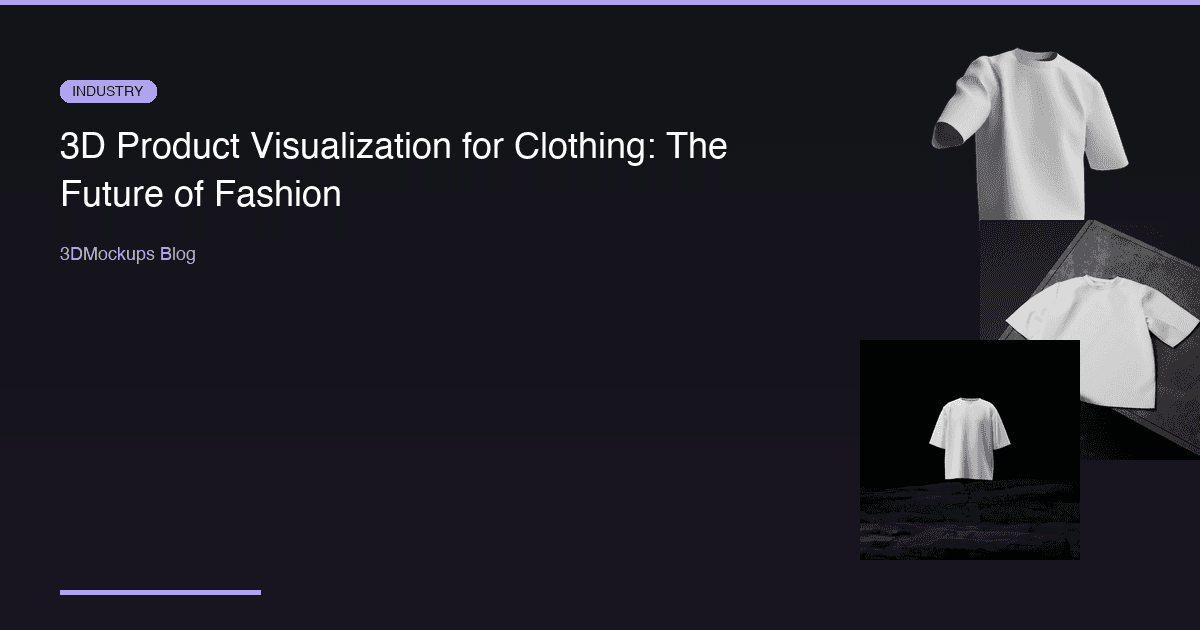
The fashion industry is undergoing a digital transformation, and 3D product visualization is at the center of it. What started as a tool for large fashion houses with dedicated 3D teams has become accessible to independent brands, print-on-demand sellers, and solo designers. The impact on how products are created, marketed, and sold is profound.
The Problem with Traditional Product Photography
Every new design, every colorway, every collection requires a photoshoot. For a growing apparel brand, that means:
- Hiring photographers and models for each shoot
- Renting studio space or scouting outdoor locations
- Producing physical samples of every design in every color before you can photograph them
- Post-production editing to ensure color accuracy and remove imperfections
- Weeks of turnaround time from concept to final product image
For a brand with 50 products in 5 colorways each, that is 250 individual product images needed. Factor in multiple angles per product and the number climbs to 750 or more. The cost adds up fast — a single product photoshoot can run anywhere from 200 to 2000 dollars depending on the production quality.
Beyond cost, there is the time factor. The fashion industry moves fast. Trends emerge and fade within weeks. If your photography pipeline takes three weeks from design finalization to product images, you are already behind your competitors who can generate mockups the same day they finish a design.
And then there is the sustainability question. Every physical sample produced for photography represents materials, manufacturing energy, and shipping emissions. Most of these samples never get sold — they exist purely for marketing purposes.
Enter 3D Visualization
3D product visualization replaces physical photography with digital rendering. Upload your design to a virtual garment model, and the rendering engine produces photorealistic images indistinguishable from real photographs. The technology uses the same rendering principles that power modern video games and animated films, adapted for the specific needs of product imagery.
The fundamental shift is from capturing light (photography) to simulating light (rendering). A photograph is limited by the physical conditions when it was taken — the lighting, the angle, the model, the environment. A 3D render can be modified after the fact, relit, recolored, and recomposed without any additional production work.
Benefits for Fashion Brands
Speed: Generate mockups in seconds, not weeks. Launch new products the same day you finalize the design. When a trend emerges, you can have products listed with professional imagery before your competitors have booked a photographer.
Cost: Eliminate photoshoot expenses. One 3D model serves unlimited designs and colorways. The per-image cost approaches zero once you have your workflow established, compared to the per-image cost of photography that never decreases.
Consistency: Every product image has the same lighting, angle, and quality. No more variation between photoshoots caused by different photographers, different studios, or different times of day. This visual consistency is particularly important for brands that sell on platforms where products from multiple brands are displayed side by side.
Scale: Add 100 new products to your store in a day. Each one with multiple angles and color options. This level of output is physically impossible with traditional photography without a massive production team.
Sustainability: No physical samples needed for marketing. Reduce waste in the design-to-market pipeline. As consumers increasingly value sustainability, brands that minimize their environmental footprint gain a competitive advantage even in their production processes.
Iteration: Test designs before committing to manufacturing. See how a print looks on different garment types, in different colors, from different angles — all before ordering a single sample. This reduces the risk of producing designs that do not sell.
Real-World Impact
The adoption of 3D visualization in fashion is accelerating, and the results are measurable:
- Brands report 70% reduction in time-to-market — from design finalization to products listed with professional imagery
- Product photography costs drop by 80% or more — the initial investment in 3D tools pays for itself within the first collection
- Return rates decrease by 25% due to more accurate product representation — when customers receive exactly what the mockup promised, they keep it
- Marketing teams can create content 10x faster — generating social media assets, email banners, and advertising creative becomes a minutes-long task instead of a weeks-long project
These improvements compound over time. A brand that adopts 3D visualization early builds a content library faster, iterates on designs more quickly, and responds to market trends with less friction than competitors still reliant on traditional photography.
How Modern 3D Mockup Tools Work
The technology behind 3D product visualization has become remarkably accessible. Modern tools like 3DMockups abstract away the complexity, making professional-grade rendering available to anyone:
1. Choose a garment model — realistic 3D models with accurate fabric physics that simulate how real garments look and move. These models are created by 3D artists who specialize in garment simulation, ensuring the folds, seams, and proportions match real products.
2. Apply your design — upload your artwork as a standard image file and it maps automatically to the 3D surface. The UV mapping process, which used to require specialized 3D skills, is handled entirely by the software.
3. Customize — change colors, adjust placement, rotate the camera, and fine-tune every aspect of the mockup in real-time. Every change is rendered instantly, so you can experiment freely.
4. Export — download high-resolution images or video. Standard exports work for web and social media, while pro exports deliver 4K quality suitable for print and large-format displays.
No 3D modeling expertise required. No expensive software licenses. No render farms or waiting for images to process. The barrier to entry has never been lower.
The Technology Behind the Scenes
For those curious about the technical foundations, modern 3D mockup generators rely on several key technologies:
WebGL and GPU rendering — the same graphics technology that powers web-based games now renders photorealistic product imagery in real-time. Modern GPUs, even in laptops and phones, are powerful enough to produce high-quality renders instantly.
Physically-based rendering (PBR) — materials are defined by their physical properties like roughness, metallicity, and subsurface scattering. This means fabric looks like fabric, ceramics look like ceramics, and lighting behaves naturally across all materials.
UV mapping — the process of projecting a 2D design onto a 3D surface. Automated UV mapping algorithms ensure your design wraps around the garment naturally, following the contours of the fabric.
Fabric simulation — physics engines calculate how fabric hangs, folds, and moves based on its weight, stiffness, and stretch properties. This is what makes 3D mockups look realistic rather than like a texture painted onto a rigid shape.
The Competitive Advantage
Brands that adopt 3D visualization today gain a significant edge across multiple dimensions:
- Faster iteration — test designs before manufacturing and only produce what you are confident will sell. This reduces inventory risk and dead stock.
- Better customer experience — realistic, multi-angle mockups on product pages build buyer confidence and reduce the uncertainty that leads to abandoned carts.
- Lower costs — spend less on photography and more on product development, marketing, or other growth activities.
- Higher conversions — realistic mockups build buyer confidence. When the product image clearly shows how the garment looks, customers are more willing to complete the purchase.
- Content velocity — the ability to generate professional imagery instantly means you can maintain an active social media presence, update your product listings frequently, and respond to seasonal trends without production bottlenecks.
The Future of Fashion E-Commerce
3D product visualization is not the final step in the evolution of online fashion retail. It is the foundation for several emerging technologies:
Virtual try-on — using 3D garment models combined with body scanning or AR, customers will be able to see how a garment looks on their own body before purchasing. This technology is already in early deployment at major retailers.
Interactive product pages — instead of scrolling through a gallery of static images, customers will rotate, zoom, and interact with 3D product models directly on the product page. Some brands are already implementing this with WebGL-based viewers.
AI-generated styling — combining 3D product models with AI styling recommendations will let customers see how a garment looks as part of a complete outfit.
The brands that invest in 3D visualization today are building the infrastructure for these future capabilities. Every 3D model, every rendered image, every workflow they develop becomes an asset that grows in value as the technology evolves.
Getting Started
The transition does not have to be all-or-nothing. Start by creating 3D mockups for your next product launch. Compare the results — speed, cost, and conversion rate — against your traditional photography workflow. Run the numbers honestly and see which approach delivers better results for your specific situation.
Most brands start with a single product category — usually t-shirts, since they are the most common apparel item — and expand from there as they see the benefits. Within a few weeks, the 3D workflow becomes second nature, and going back to traditional photography feels slow by comparison.
The tools are accessible, the learning curve is minimal, and the results speak for themselves. The question is not whether your brand will adopt 3D visualization, but whether you will adopt it before your competitors do.
Ready to create your first mockup?
Try 3DMockups Free